Satoyama describes human-influenced landscapes whose woods, fields and waters are connected by local practices and changing livelihoods.
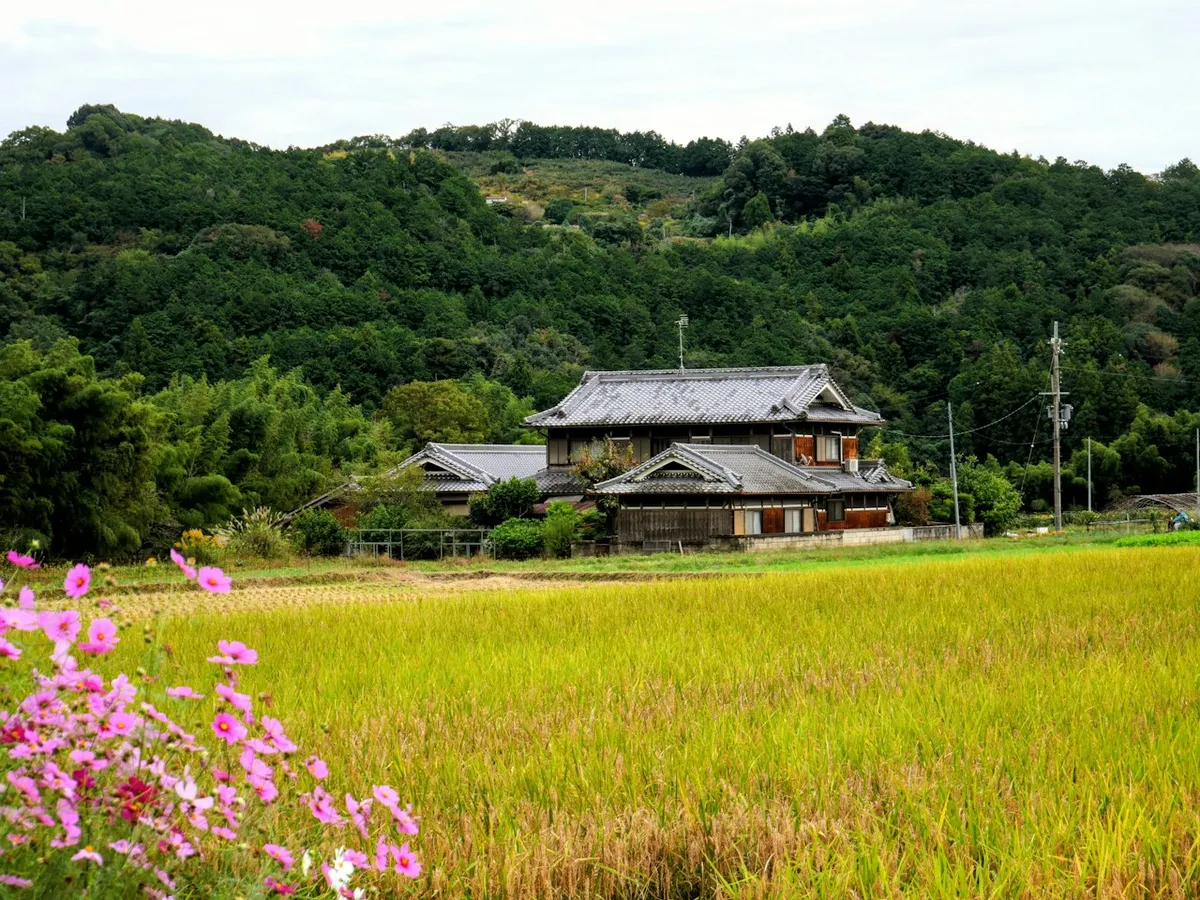
The photograph illustrates a Japanese rural landscape; it does not establish a specific satoyama management practice. The ministry sources describe a framework and examples, not every community or species.
Look at the spaces between
A woodland, rice field and village may look like separate places on a map. Japan’s Ministry of the Environment uses the term satoyama landscape to describe a more connected picture: managed woods and grasslands alongside fields, ponds and settlements. People have used and cared for many of these environments over long periods.
This is a way to understand particular rural landscapes, not a claim that people have always managed nature sustainably. The Japanese term has several uses; the broader landscape sense here follows the ministry’s satoyama pamphlet.
Why managing a woodland can matter
The pamphlet describes coppicing: periodically cutting certain trees so that shoots can grow again from the stump. Wood can be used as fuel, while fallen leaves have been collected for compost. These actions also affect how much light reaches the woodland floor.
The ministry explains that when demand for wood fuel declined, some coppices were no longer managed in the same way. Denser growth can reduce habitat for plants that depend on an open woodland floor. This is a description of particular managed habitats; it is not evidence that every forest should be cut or that a less-managed forest is always poor habitat. Different species need different conditions.
Change the practice, change the landscape
The ministry’s biodiversity report treats paddies, channels, ponds and coppices as a variety of human-influenced habitats. It also describes losses from development and changes in farming practices. A landscape may change when people leave, when markets change, or when work that once supported a livelihood becomes difficult to continue.
Who decides what to maintain matters as much as what looks attractive from outside. The ministry’s collection of management examples includes many approaches rather than one prescription. Its categories are an institutional framework, not a substitute for the needs and knowledge of people in a particular place.
A way to observe your own surroundings
Notice a field edge, a drainage channel or a patch of trees near a settlement. Which parts are regularly tended, and which species seem to use them? Observation is a starting point, not a reason to copy a woodland technique without understanding local conditions or permissions.
For another view of a working landscape, read about miang tea gardens in northern Thailand. They are distinct places and practices, connected here by a question: how do livelihoods shape the plants and habitats around them?
Sources & further reading
- Japan Ministry of the Environment · Satoyama landscape pamphlet ↗
- Japan Ministry of the Environment · Practices and management ↗
- Japan Ministry of the Environment · Biodiversity report ↗
This founding-edition article was drafted with AI assistance and checked against the sources above. It has not had independent expert review. Read our editorial approach.