Dragonflies spend part of their lives as aquatic larvae. Protecting their habitat means considering the water and its edges, not only the adults in flight.
In this story
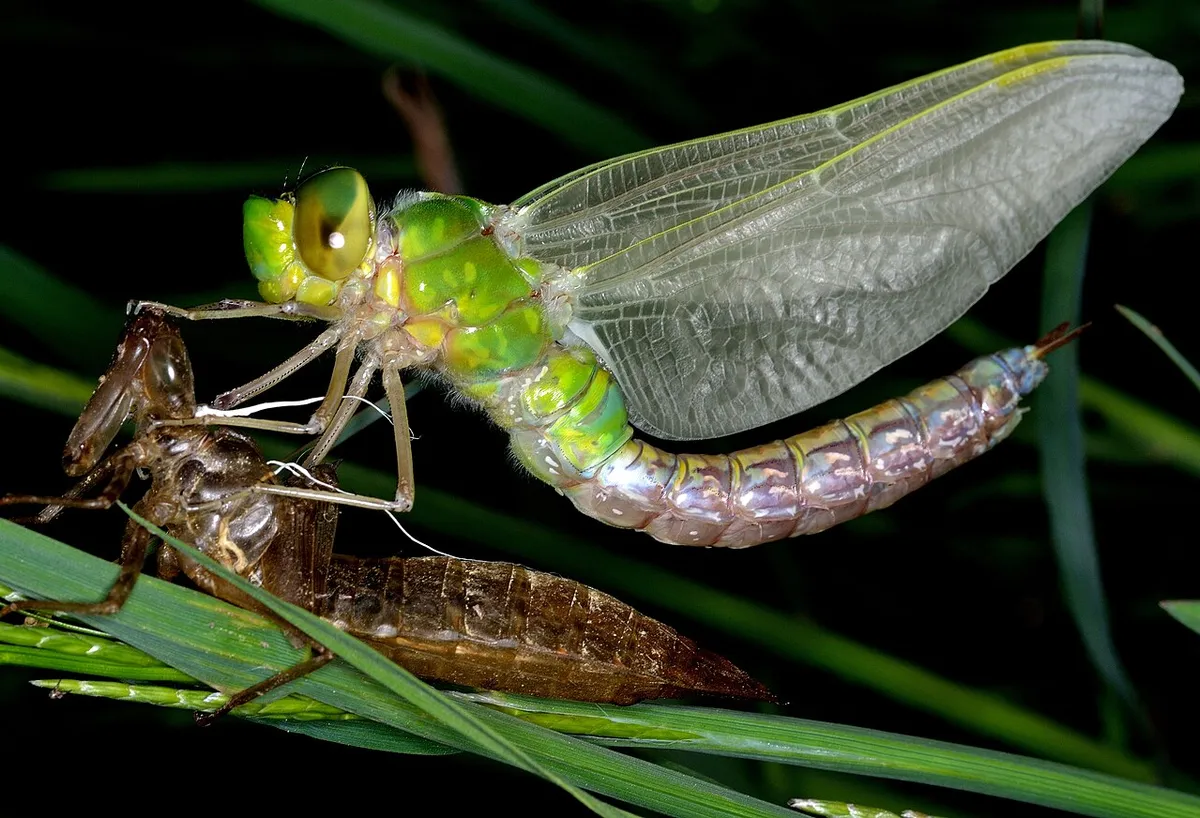
The credited image shows an emperor dragonfly emerging beside its shed larval skin, not its underwater life. Life-cycle timings and local habitats vary by species and region.
The flight is only one part of the story
A dragonfly crossing a pond looks perfectly at home in the air. Yet the young animal lives a very different life. After the egg hatches, the larva hunts underwater before emerging as a winged adult. The British Dragonfly Society describes three stages: egg, larva and adult. There is no separate pupal stage, unlike a butterfly’s life cycle.
The details depend on the species. Eggs may be laid in water or in material such as plant stems near it. The society’s British examples of dragonflies and damselflies show larval development ranging from months to more than five years; these figures are examples, not a timetable for every dragonfly in Thailand or elsewhere.
A predator under the surface
A dragonfly larva has six legs and an extendable lower jaw that helps it catch prey. Depending on its size and surroundings, it may eat aquatic insect larvae, worms or other small animals. Larvae can themselves be eaten by fish, birds and other predators. The adult also hunts, catching flying insects rather than feeding on the same prey in the same way.
It is tempting to treat every dragonfly as a mosquito-control service. Adults can eat mosquitoes, as Smithsonian Gardens notes, but one sighting does not tell you how many mosquitoes have been eaten or whether the insect will stay nearby. Avoid introducing animals or changing water management on that assumption.
A fragile moment at the water’s edge
When ready for its final moult, a larva leaves the water and finds support. The adult gradually emerges from the old skin, expands its wings and hardens before flying. The empty casing is called an exuvia. The British Dragonfly Society describes this transition and notes that the newly emerged adult is vulnerable while its body is still soft.
If you notice an emergence, watch from a respectful distance. Leave the insect and its support undisturbed; a slow transition is not by itself evidence that the animal needs help. An empty casing can show that an insect emerged there, but identifying its species may need local expertise.
What a pond needs depends on its residents
The society’s wetland guide, written for Britain, describes submerged plants and vegetation above the water as useful features for different life stages. It also notes that fish can eat larvae. These are starting points for understanding habitat, not a universal pond-design recipe: local species, climate, water quality and regulations matter.
A garden pond also creates responsibilities. Consider child and pet safety, local mosquito-management advice, water availability and maintenance before making one. Never move wild larvae or release non-native plants or animals to stock a pond.
Try a patient observation
From a safe public path or an edge you have permission to visit, note the date, weather and what the insect actually does: perches, flies, mates or dips toward the water. Is there vegetation at the edge? Return another day if you can. One adult flying over water does not prove it developed there or establish the water’s quality. Keep a short record in a field notebook, and compare this water habitat with the land-and-water design of a rain garden.
Sources & further reading
- British Dragonfly Society · Life cycle and biology ↗
- Smithsonian Gardens · Dragonflies ↗
- British Dragonfly Society · Dragonflies and their wetlands ↗
This founding-edition article was drafted with AI assistance and checked against the sources above. It has not had independent expert review. Read our editorial approach.